
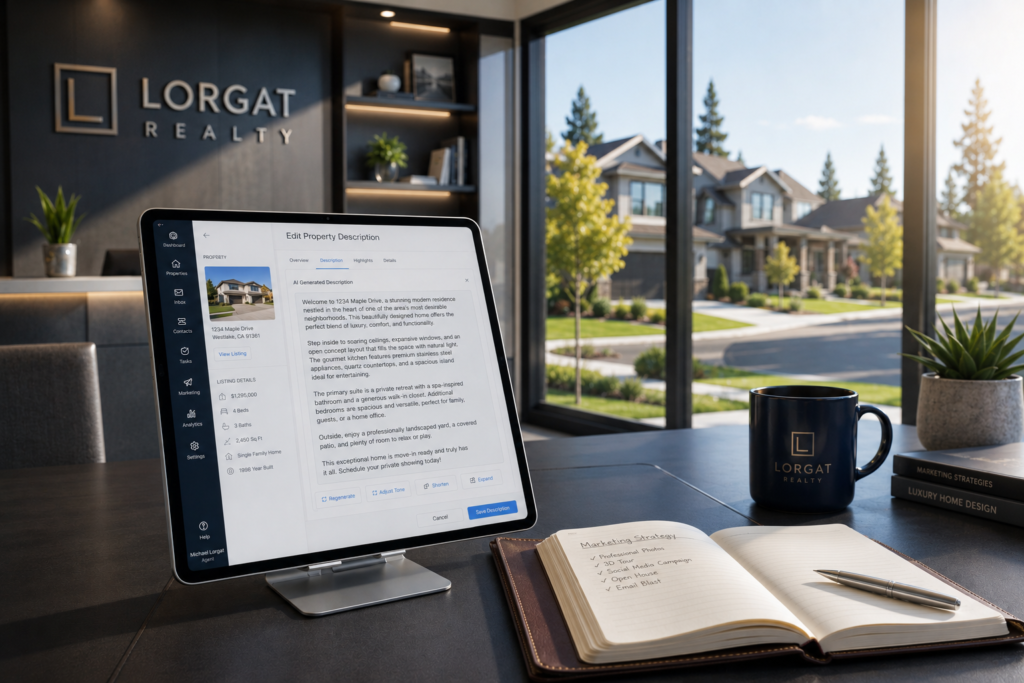
Stop Wasting Money on Generic MLS Listings. It’s Masking the Core Structural Flaw in Real Estate Marketing…
If you are still struggling to write compelling property copy by hand, learning how to use ChatGPT for MLS descriptions will completely change your real estate business workflow. The contemporary residential real estate landscape is experiencing an unexamined crisis of attention. Every single day, thousands of licensed real estate agents log into their local Multiple Listing Services to upload details for newly acquired properties, yet the vast majority of these listings default to a broken copy-and-paste formula. By relying on a dry sequence of property characteristics, standard dimension counts, and unreadable industry shorthand, professionals unintentionally mask the underlying value of their listings. This sterile data presentation completely fails to engage the human psychology of prospective purchasers, reducing what should be an aspirational lifestyle discovery into a cold, transactional calculation that gets immediately ignored in an overcrowded digital marketplace.
When an active buyer scrolls through online aggregators, they encounter a numbing wall of text repetition. Listings routinely lead with identical, unimaginative opening hooks like “Beautiful 4-bedroom, 2-bathroom home located in a great neighborhood.” This systemic lack of imagination represents a devastating marketing flaw. Human beings do not make multi-hundred-thousand-dollar asset purchases based entirely on raw material specifications; instead, they buy the future narrative of their lives. When real estate agents fail to deliver an immersive story within the first two sentences of a public remarks section, they systematically suppress their click-through metrics, push up their average days on market, and accumulate stale listing histories that compromise their negotiating leverage.
The hidden operational cost of this structural copy breakdown is severe. Busy real estate professionals frequently spend hours staring at a blank screen, struggling to synthesize architectural data into persuasive sales copy, only to settle for uninspired summaries out of sheer administrative exhaustion. Alternatively, outsourcing this critical copy production to traditional agencies introduces recurring overhead costs that erode overall commissions. In an environment where market visibility dictates velocity, continuing to deploy unoptimized public remarks means leaving an agent’s personal brand equity vulnerable to competing professionals who understand how to structure high-impact real estate marketing campaigns.
- Shift from Features to Structural Benefits: Learn how to systematically convert dry physical property attributes into emotionally resonant lifestyle outcomes that capture immediate buyer attention.
- Implement Programmatic Pattern Interrupts: Master the tactical deployment of unique opening hooks that disrupt passive online scrolling and force deep consumer interaction.
- Deploy the Real Estate AI Prompt Library: Leverage a dedicated, battle-tested framework of engineered AI prompts to automate professional communication and convert cold leads on autopilot.
Rethinking Traditional MLS Descriptions: Moving Beyond the Data Box
To overcome the limitations of standard real estate copy, realtors must deliberately shift away from the legacy practice of feature-heavy data listing. For decades, the industry has trained professionals to treat the public remarks field as a secondary repository for facts that are already visible in the numerical data fields. Documenting that a property contains a specific number of square feet, a double garage, or an open-plan kitchen adds zero cognitive value for a modern consumer who has already filtered their online search parameters by those identical variables. This execution strategy results in massive text redundancy, wasting premium character limits on administrative repetition.
The true objective of high-retention public remarks is to construct a compelling lifestyle narrative that a buyer can instantly step into. Property lookups turn into active inquiries the moment a prospect experiences an emotional connection to the space. If your copy layout treats a luxury master suite merely as an insulated space with specific dimensions, you miss the core psychological driver of the transaction. Real estate marketing must articulate how the physical architecture serves the occupant’s daily life, translating cold construction materials into fluid human experiences.
Achieving this level of creative output across multiple active listings requires an optimization workflow that bypasses human creative fatigue. This is where utilizing ChatGPT for realtors, guided by structured prompt guidelines, completely changes the operational equation. By feeding raw data parameters into engineered AI prompts, agents can instantly generate a variety of unique, context-aware property descriptions. This methodology turns an administrative chore into a scalable marketing workflow, ensuring that every home on your roster receives elite copy presentation regardless of individual client budgets or time constraints.
By upgrading the public remarks architecture, realtors establish clear brand differentiation. In a professional ecosystem where past performance dictates future client acquisitions, publishing narrative-driven listings signals an elite tier of marketing competency to prospective home sellers. Moving past traditional data boxes allows professionals to reclaim their schedule, save hundreds of writing hours, and deliver an elevated standard of professional communication that keeps their business ahead of standard industry averages.
The Mechanism Behind Emotional MLS Content: Features vs. Benefits
The biological mechanism of a real estate transaction is deeply rooted in emotional justification. Neuropsychological data confirms that consumers make high-ticket purchases based on subconscious emotional alignment, utilizing logical facts afterward to validate the decision. Despite this reality, traditional real estate copy continues to lead with logical components while ignoring emotional triggers. To reverse this trend, realtors must master the distinction between a structural feature and an experiential benefit, adjusting their content delivery to target consumer desires directly.
A feature represents the objective, physical reality of an architectural component. For example, stating that a home has a “four-bedroom layout,” “quartz kitchen countertops,” or a “fenced backyard deck” outlines functional features. These facts are necessary, but they are completely devoid of emotional pull. They explain *what* the asset contains, but they fail to articulate *why* the prospective buyer should care. When your marketing text stops at the feature layer, it treats your listing like a generic commodity, forcing consumers to compare your property against others solely on price-per-square-foot ratios.
An experiential benefit represents the positive human transformation that a specific feature enables. When you run raw listing data through the Real Estate AI Prompt Library, the underlying engine translates features into immediate lifestyle upgrades. A four-bedroom layout transforms into “the dedicated space needed to host your entire family for Thanksgiving dinner without feeling crowded.” Quartz countertops become “a stress-free prep station where your guests can gather around the central island during weekend dinner parties.” A backyard deck becomes “the perfect setting for quiet Sunday morning coffee while watching the sun rise over the lawn.”
This subtle adjustment completely reconfigures consumer perception. By focusing content on human benefits, you trigger immediate visualization inside the buyer’s mind. The reader stops evaluating the house as a compilation of drywall and timber, and begins viewing it as the safe setting for their family’s future memories. This deep engagement directly converts cold digital leads into motivated buyers who are ready to attend open houses and book private showings.
Grab the Full Real Estate AI Prompt Library Here
How AI Transforms Your Real Estate Listings: The Core Pillars
Deploying the Real Estate AI Prompt Library into your daily business workflow introduces a deliberate framework designed to eliminate guesswork. The entire architecture rests on three core pillars that transform raw property facts into high-converting sales copy. The first pillar focuses on the conversion of Feature vs. Benefit profiles. Instead of requiring realtors to manually brainstorm lifestyle narratives for every appliance, room, and exterior amenity, the engineered AI prompts systematically scan the property details and output tailored lifestyle benefits that hook target buyer profiles.
The second pillar centers on Emotional Architecture. This discipline requires the layout to mirror the natural physical flow of a live property walkthrough. Standard descriptions often jump erratically from the basement details to the roof age, creating cognitive dissonance for the reader. The library’s listing generator prompts enforce a logical progression: entering through the front door, experiencing the natural light of the main living space, moving into the kitchen hub, and transitioning to the private outdoor areas. This structured layout guides the reader’s attention smoothly, building a coherent mental image of the home’s atmosphere.
The third pillar is the execution of a strict Pattern Interrupt within the first 60 characters of the text. Because digital portals display only a brief snippet of copy before a user must click “read more,” standard introductory phrases waste premium visual space. The library leverages calculated hook frameworks that instantly stop a user’s passive scrolling. By leading with an unexpected lifestyle statement or a striking architectural highlight rather than generic neighborhood greetings, the system breaks portal monotony, driving higher click-through rates and maximizing initial buyer interest.
Furthermore, this systematic automation integrates directly with daily professional communication needs. Beyond basic public remarks, the library enables realtors to quickly repurpose a single property profile into a multi-channel content framework. With a single data paste, agents can generate optimized captions for social media reels, targeted copy for email follow-ups, and structured scripts for property video tours. This systemized deployment saves realtors over 10 hours per week, allowing them to redirect their focus away from administrative copy tasks and toward client-facing negotiations.
Comparing Market Solutions

| Features | Real Estate AI Prompt Library | Traditional MLS Templates | Generic AI Chat Tools |
|---|---|---|---|
| Focus on Benefits | Natively built to translate physical property details into specific lifestyle benefits automatically. | Completely absent; relies entirely on manual input of standard property dimensions. | Inconsistent; requires users to write complex follow-up commands to avoid generic responses. |
| Story-Driven Content | Yes; uses specific frameworks to construct an immersive spatial narrative for the reader. | No; limits layout options to simple, disconnected data summaries and abbreviations. | Often outputs robotic or exaggerated text that sounds artificial without deep editing. |
| Workflow Automation | Highly streamlined; provides 35 plug-and-play prompts for listings, emails, and follow-ups. | Manual execution; requires typing every public remark entry from scratch. | Fragmented; requires the user to invent their own prompt architecture for every property. |
| Lifestyle Appeal | High; optimizes content layout to target the precise emotional triggers of home buyers. | Extremely limited; restricts visibility to raw construction facts and material specifications. | Moderate; tends to apply generic adjectives that lack local market authenticity. |
Frequently Asked Questions
How can ChatGPT and the Real Estate AI Prompt Library benefit realtors?
The combination of ChatGPT and the Real Estate AI Prompt Library allows realtors to eliminate writing blockages, automate daily professional communication, and elevate their brand positioning. By feeding raw data into highly targeted, engineered AI prompts, agents can transform dry property profiles into compelling lifestyle narratives that build deep consumer trust. This systemic automation saves hours of desk work every week, allowing active agents to focus on client acquisition, property tours, and closing deals.
Is using AI to write MLS descriptions complicated for beginners?
Not at all. The entire library is constructed around a clear, fill-in-the-blank system designed to eliminate technical barriers. Users simply browse the library to select a specific prompt framework, input their basic property facts into the clearly marked text fields, and copy-paste the template into their AI interface. The system delivers predictable, professional-grade marketing copy in seconds without requiring prior prompt engineering experience or technical training.
Can this solution handle different types of property listings and tones?
Yes. The library is built with high modular flexibility, allowing professionals to tailor outputs to match any property asset class or brand aesthetic. Whether you need to generate sophisticated, aspirational language for an exclusive luxury estate, clear and educational text for a first-time buyer condominium, or data-driven analysis focused on return on investment for commercial buyers, the prompts adjust their parameters to match your target audience.
Final Thoughts
The craft of producing public remarks for real estate listings does not have to be a tedious administrative chore. Continuing to rely on outdated, feature-heavy templates hurts your brand’s digital visibility and limits your conversion potential in an increasingly fast-paced market. Transitioning to a benefit-focused strategy allows active agents to break through online noise, capture homebuyer interest instantly, and establish professional authority across all digital channels.
The Real Estate AI Prompt Library provides a highly effective shortcut to achieve this automation across your entire business. With 35 battle-tested prompts covering everything from landing page hooks to personalized client nurture campaigns, this digital asset removes creative exhaustion from your schedule. Implementing this framework into your quarterly business planning ensures your marketing remains consistent, high-converting, and aligned with modern professional communication standards.
Embracing automated workflows is the separating variable for scaling businesses over the coming years. By delegating copy production to a systemized AI framework, you protect your time, elevate your presentation standards, and turn cold listing traffic into warm buyer inquiries. Discover how this digital toolkit can streamline your marketing architecture and give you back valuable hours every week.
Grab the Full Real Estate AI Prompt Library Here
About Yaseen
Yaseen is a Senior Automation Engineer and the Lead Researcher at Age Smarter Life. Applying over six years of rigorous systems testing and analytical architecture, he evaluates longevity protocols and business automation workflows based on clinical data and systemized results, not marketing hype.