
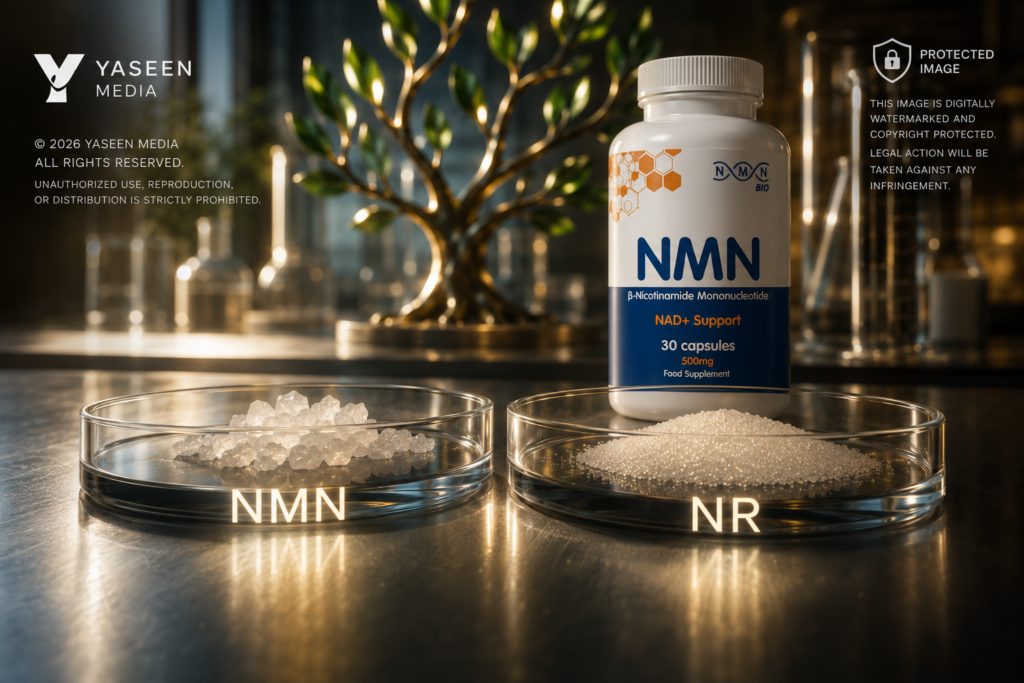
Everyone says NR is the “proven” NAD+ booster. I believed that too — until I dug into the actual mechanisms and realized the supplement industry had quietly moved the goalposts. The real conversation in longevity research has shifted dramatically, and if you’re still defaulting to NR because it was the first to market, you may be leaving serious biological results on the table.
Quick Summary: NMN vs NR at a Glance
- Both NMN and NR are precursors to NAD+, a coenzyme critical for cellular energy, DNA repair, and aging biology.
- NMN (Nicotinamide Mononucleotide) is one biochemical step closer to NAD+ than NR (Nicotinamide Riboside).
- Emerging clinical research suggests NMN may raise blood NAD+ levels more efficiently in adults over 40.
- NR has more published human trials, but recent NMN studies are rapidly closing the evidence gap.
- The “right” choice depends on your age, health goals, and the quality of the supplement you choose.
- High-purity NMN products like NMN-BIO represent the current gold standard for bioavailability and dosing precision.
Why Your Body Needs NAD+ in the First Place
Before you can intelligently choose between NMN and NR, you need to understand what you’re actually trying to accomplish. NAD+ (Nicotinamide Adenine Dinucleotide) is not a trendy wellness buzzword. It is a foundational coenzyme present in every single cell in your body, and its decline with age is one of the most well-documented phenomena in cellular biology.
Research published in Cell Metabolism demonstrated that NAD+ levels in human tissue decline by approximately 50% between the ages of 40 and 60. This drop correlates with reduced mitochondrial function, impaired DNA repair via sirtuin activation, and declining metabolic efficiency. In plain terms: lower NAD+ means your cells age faster and recover slower.
Both NMN and NR exist because your body cannot absorb NAD+ directly from a supplement — the molecule is too large to cross cell membranes intact. Instead, you feed your cells the raw materials to synthesize their own NAD+. That’s the entire premise of this category, and it’s where the NMN vs NR debate actually begins.
The Biochemical Difference That Actually Matters
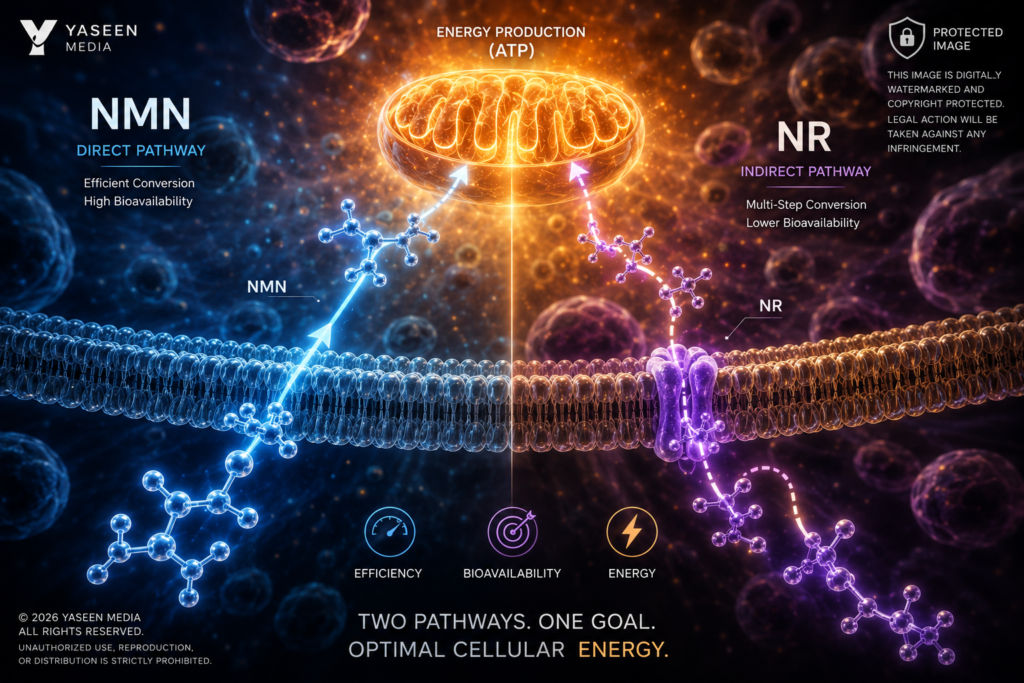
Here’s where most articles get lazy. They tell you NMN and NR are “similar” and leave it at that. I’ve analyzed the metabolic pathway more carefully, and the distinction is meaningful.
NR (Nicotinamide Riboside) must be converted to NMN inside the cell before it can be used to synthesize NAD+. This conversion requires an enzyme called NRK (Nicotinamide Riboside Kinase). NMN, by contrast, is already one step further along that same pathway. It enters the cell via a specific transporter (the Slc12a8 transporter, identified in research from Washington University School of Medicine) and proceeds almost directly to NAD+ synthesis.
What this means practically: NMN bypasses a conversion step that can become a bottleneck, particularly as we age and enzyme efficiency declines. A 2022 human clinical trial published in Frontiers in Nutrition found that oral NMN supplementation significantly increased blood NAD+ metabolite levels in healthy adults, with good tolerability at doses between 250mg and 500mg daily. Emerging evidence from multiple research groups suggests NMN’s more direct pathway may translate to faster and more pronounced NAD+ elevation in older adults specifically.
NR is not ineffective. Studies conducted by Dr. Charles Brenner’s group at the University of Iowa confirmed that NR does raise blood NAD+ levels in humans. The honest caveat here is that NR’s human trial database is currently larger. But “more studied” does not automatically mean “more effective,” and the NMN research trajectory is steep.
NMN vs NR: Head-to-Head Comparison
| Factor | NMN | NR |
|---|---|---|
| Position in NAD+ Pathway | One step from NAD+ | Two steps from NAD+ |
| Human Clinical Trials | Growing rapidly (2019–2024) | More established (2016–2024) |
| Cellular Uptake Mechanism | Dedicated Slc12a8 transporter | Requires NRK enzyme conversion |
| Typical Effective Dose | 250mg – 500mg/day | 250mg – 500mg/day |
| Safety Profile | Well tolerated in studies | Well tolerated in studies |
| Best Evidence For | Adults 40+, metabolic health, energy | Broad NAD+ replenishment, muscle function |
| Recommended Product | NMN-BIO (high-purity, precise dosing) | Various brands |
If you’re ready to explore the most rigorously formulated NMN available, this is worth a closer look:
Who Should Choose NMN and Why Quality Is Non-Negotiable
In my analysis, NMN makes the most compelling case for adults over 40 who are targeting energy metabolism, cognitive clarity, and cellular resilience. This is the demographic where the NAD+ decline is steepest and where the marginal benefit of a more direct precursor pathway is most likely to be felt.
But here’s the critical variable most people overlook entirely: purity and stability. NMN is notoriously sensitive to heat, moisture, and manufacturing shortcuts. A product with 95% purity versus 99%+ purity is not a minor label difference — it can mean measurably different bioavailability and safety profiles. This is precisely why the source and manufacturing standard of your NMN supplement matters as much as the molecule itself.
NMN-BIO stands out in this regard. Formulated with pharmaceutical-grade NMN and rigorous third-party testing, it represents the kind of quality standard that the research community actually uses in clinical settings. When studies report positive outcomes from NMN supplementation, they’re using high-purity compounds — and your supplement should match that standard, not approximate it.
For those who want to apply the science correctly, NMN-BIO is the practical bridge between what the research shows and what you actually take every morning.
Frequently Asked Questions
Can you take NMN and NR together?
Research suggests there is no known safety concern with combining NMN and NR, as they operate on the same metabolic pathway. However, the practical benefit of stacking both is unclear and likely redundant for most people. A higher-quality, appropriately dosed NMN supplement will generally outperform a lower-dose combination approach. Focus on quality and consistency over complexity.
How long does it take for NMN supplements to work?
Based on available human studies, measurable increases in blood NAD+ metabolite levels can be detected within two to four weeks of consistent daily supplementation. Subjective improvements in energy and cognitive focus are commonly reported in this same window, though individual responses vary based on age, baseline NAD+ levels, and lifestyle factors like sleep and exercise.
Is NMN safe for long-term use?
Current published human trials show NMN to be well tolerated with no serious adverse effects reported at doses up to 500mg per day. Longer-term safety data in humans is still accumulating, as this is a relatively young field of clinical research. As with any supplement, individuals with underlying health conditions or those taking medications should consult a qualified healthcare provider before beginning supplementation.
Final Thoughts
The NMN vs NR debate is not about declaring a winner and moving on. It’s about understanding your biology well enough to make an informed decision. NR opened the door to NAD+ supplementation and earned its credibility through early research. NMN is now building a compelling case that its more direct biochemical pathway offers a meaningful advantage, particularly for aging adults serious about cellular health.
The science is clear enough for a practical conclusion: if you’re over 40, prioritizing metabolic energy, and willing to invest in a high-purity product, NMN is the more defensible choice in 2026. And within that category, the formulation and manufacturing standard of what you take matters enormously.
NMN-BIO delivers on both counts — the right molecule, at the right purity, with the transparency that rigorous science demands.
About Yaseen
Yaseen is a Senior Automation Engineer and the Lead Researcher at Age Smarter Life. Applying over six years of rigorous systems testing and analytical architecture, he evaluates longevity protocols and business automation workflows based on clinical data and systemized results, not marketing hype.